Henri Rousseau – Tropical Forest with Monkeys, 1910 | Giclée Print


Henri Rousseau – Tropical Forest with Monkeys, 1910 | Giclée Print
Free shipping worldwide, sent rolled in a tube · 30 days to return it · Prices include Swiss VAT; orders outside Switzerland may attract local import duty on delivery. Shipping · Returns · Help
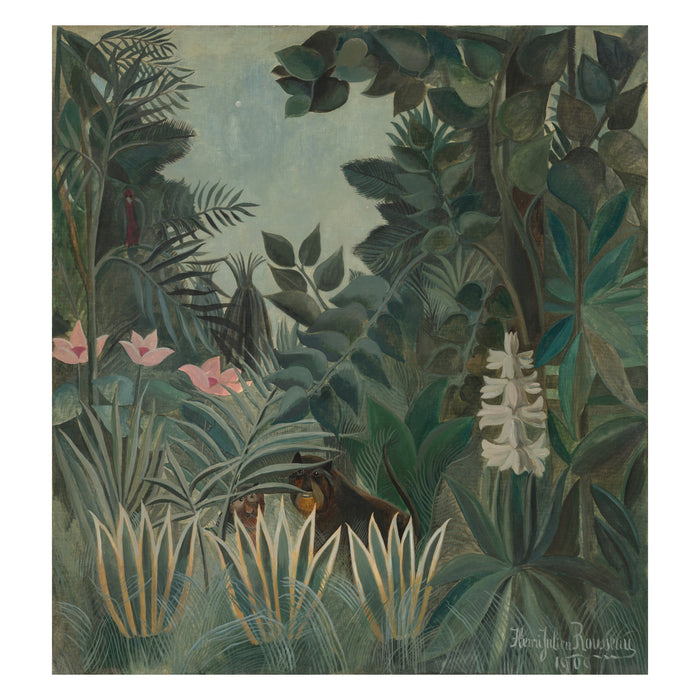
Five monkeys in a wall of leaves. One sits on a branch in the middle, black and silver, holding a white water lily as if it had been handed to him; two orange ones swing from a bough at the top right; a fifth, red-brown and almost human, stands on a rock at the front and looks straight out at you. Across the bottom runs a bank of crimson leaves that grows nowhere on earth.
Painted in the last year of his life. Rousseau signed and dated this canvas 1910 and died on 2 September of that year, aged sixty-six. It belongs to the last handful of jungles — the pictures that had been laughed at for twenty years and were about to be taken seriously by Picasso, Delaunay, Kandinsky and everyone who came after them.
He never saw a jungle. Rousseau was a Paris customs officer who painted in his free time and never left France. The plants come from the hothouses of the Jardin des Plantes, the animals from an illustrated picture book of wild beasts. That is why the scale is impossible, the botany invented and the light of no particular continent — and it is also why the picture is composed like a stage set rather than a view.
Why it works as a wall. There is no horizon and no vanishing point. The picture is built in flat layers, each leaf drawn separately, so it reads at any distance: from across the room a green field with a red foot and five dark accents; up close several hundred individually painted leaves and the small comedy of the animals. At 162 cm wide it was made to be seen from a distance, and the large sheet keeps that.
What this is. A giclée reproduction printed with pigment inks from the National Gallery of Art’s own open-access photograph of the canvas. It is not a painting and is not sold as one.
Scale
Original: 129.5 × 162.5 cm — oil on canvas, National Gallery of Art, Washington
50 × 40 cm / 19.7 × 15.7 in — reduced, 0.26× original. Image 42.00 × 33.55 cm.
80 × 60 cm / 31.5 × 23.6 in — reduced, 0.39× original. Image 63.09 × 50.40 cm.
No crop. Rousseau painted to all four edges and the museum photographed the canvas edge to edge. We sampled twenty-five rows and columns in from each side of the file and found paint everywhere — never the flat, even studio grey a photographer’s backdrop leaves. The file is printed whole; nothing trimmed, nothing added.
On the borders. On the small sheet the width binds at the house 84 %: the image is 42.00 cm wide, leaving 4.00 cm at each side, 3.00 above and 3.45 below. On the large sheet the height binds instead — the canvas is squarer than the paper — so 8.46 cm at the sides, 4.47 above and 5.13 below. Both sit at optical centre, 1:1.15, not in the middle.
Resolution. Washington’s photograph runs 41,655 × 33,278 pixels, the second largest source in this catalogue: 2519 dpi at the small size and 1677 at the large one. Both sheets print at our flat 300 dpi, the most that matte fine art paper resolves. At that floor the file would carry an image 353 cm wide — more than twice the canvas. The sheet is the limit here, not the picture.
Provenance
Henri Rousseau (French, 1844–1910), Tropical Forest with Monkeys, 1910. Signed lower right: Henri Rousseau / 1910.
Oil on canvas, 129.5 × 162.5 cm.
National Gallery of Art, Washington, John Hay Whitney Collection, acc. no. 1982.76.7.
Paul von Mendelssohn Bartholdy, Berlin; his wife, Elsa Gräfin Kesselstadt, Berlin and later Vaduz; on consignment 1950 with Walter Feilchenfeldt, Switzerland; sold 1950 to John Hay Whitney, Manhasset, New York; deeded 1982 to the John Hay Whitney Charitable Trust; gift to the National Gallery of Art, 1982.
Public domain. The museum publishes its photograph under its Open Access policy.
The print
Giclée on 200 gsm FSC-certified fine art paper, twelve pigment inks. White border, optical centre. The colour of the museum’s file is kept, not corrected. Unframed. Shipped rolled in a tube.
Further reading
Why This Print Is Not Bigger — how the file, not the sheet, sets the ceiling.