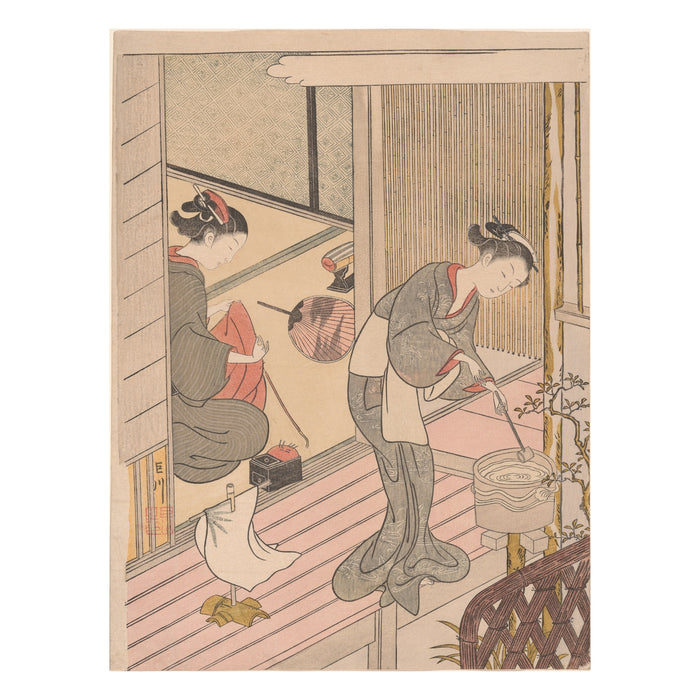
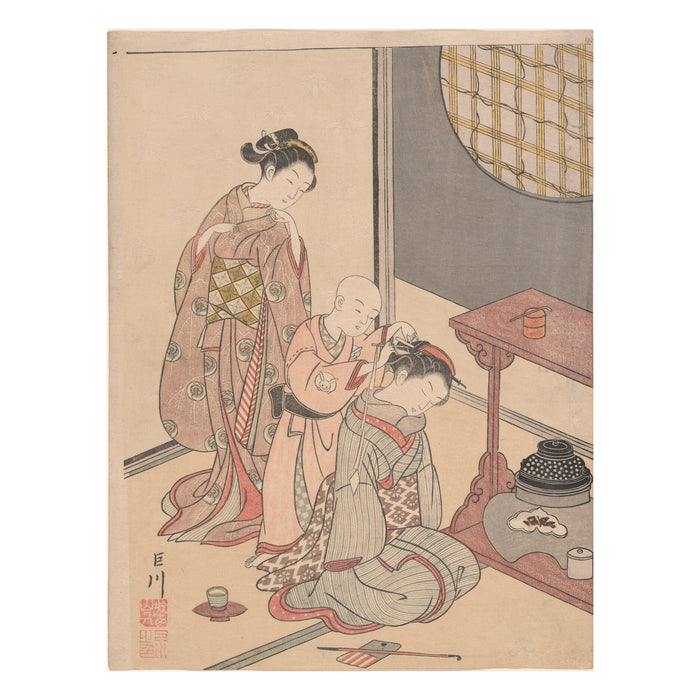
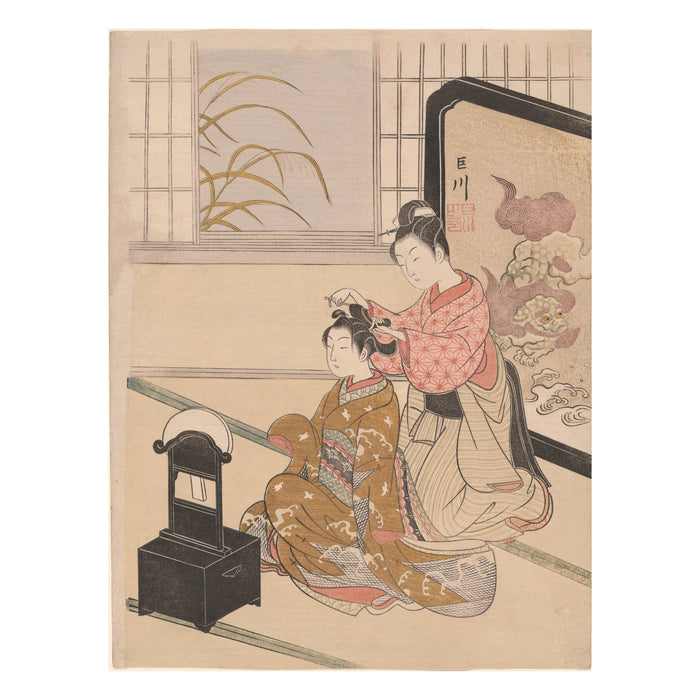
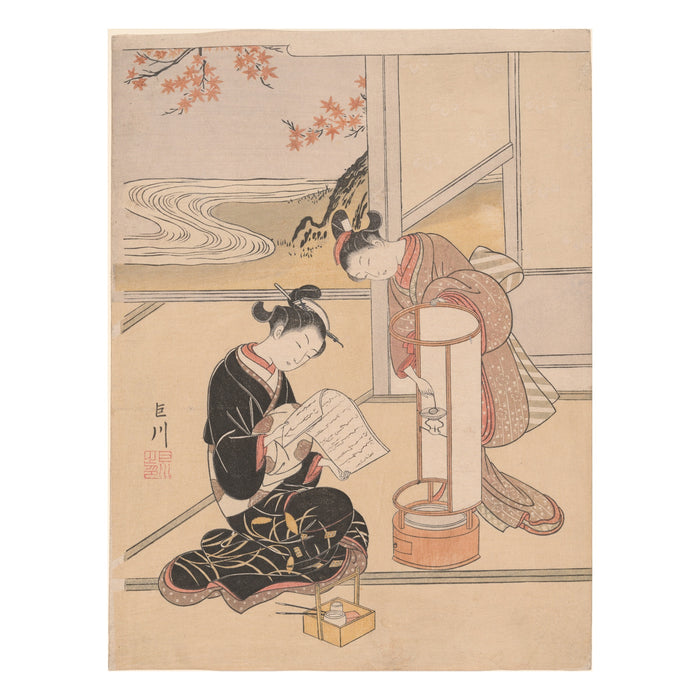
Suzuki Harunobu – Descending Geese of the Koto Bridges (Kotoji no rakugan), c. 1766 | Giclée Print
30 × 40 cm / 11.8 × 15.7 in — Original size, 1:1
CHF 49.00
Skip to product information


Suzuki Harunobu – Descending Geese of the Koto Bridges (Kotoji no rakugan), c. 1766 | Giclée Print
CHF 49.00
✓ Free worldwide shipping, sent rolled in a tube
✓ 30-day returns
✓ Damaged? Free replacement, no return needed
✓ Printed and shipped from the certified house nearest you — no customs, no long wait
The price you see is the price you pay — taxes included, nothing added at checkout. Shipping · Returns · Help
A young woman tunes a koto while another listens. The row of bridges along the instrument is the picture: in the Chinese canon this view is Wild Geese Descending to a Sandbar, and the geese have become the koto bridges, stepping down the soundboard in a line.
The series turns the old landscape cycle into eight objects in a living room — a parody, a mitate, which only works if you know the landscape it replaces. These are also among the first full-colour woodblock prints ever made, the nishiki-e Harunobu forced through from 1765.
What this is. A giclée reproduction printed with pigment inks. It is not a woodblock print and is not sold as one — a woodblock print is pulled by hand from cut cherry blocks, and the good impressions are in museums.
Scale
Original: 29 × 21.7 cm / 11 3/8 × 8 1/2 in — chūban, Art Institute of Chicago
30 × 40 cm / 11.8 × 15.7 in — Original size, 1:1
50 × 70 cm / 19.7 × 27.6 in — Enlarged, 1.7× original
Provenance
Suzuki Harunobu (Japanese, 1725–1770), Descending Geese of the Koto Bridges (Kotoji no rakugan), from the series Eight Views of the Parlour (Zashiki hakkei), c. 1766; colour woodblock print, chūban, 29 × 21.7 cm.
The Art Institute of Chicago, Clarence Buckingham Collection, Acc. No. 1928.899.
Public domain; the museum publishes its digitisation under CC0.
The print
Giclée on 200 gsm FSC-certified fine art paper, twelve pigment inks. White border, optical centre. The paper tone of the original is kept, not corrected. Unframed. Shipped rolled in a tube.